Friday, September 30, 2016

Pituitary resons and controls

How to controlling pituitary

The pituitary gland

The pituitary gland The pituitary is a powerful gland that secretes nine different hormones. Although it secretes so many hormones, it is amazingly tiny—about the size of a marble. The pituitary "marble" hangs from the underside of the brain, supported and cradled within a bony depression of the sphenoid bone. 

Controlling the pituitary: The hypothalamus

 The pituitary secretes seven major hormones from its larger front portion, or lobe, the anterior pituitary. It secretes two from its rear lobe, the posterior pituitary. The secretion of these hormones is regulated by a mass of nerve cells that lies directly above the pituitary, making up a small part of the "floor" of the brain. This regulatory nervous tissue, the hypothalamus, is connected to the pituitary by a stalk of tissue  . The hypothalamus uses information it gathers from the peripheral nerves and other parts of the brain to stimulate or inhibit the secretion of hormones from the anterior pituitary. In this way, the by pothalamus acts like a production manager, receiving in-  formation about the needs of the company's customers and regulating the production of products to satisfy those needs. The hypothalamus accomplishes its management job by producing releasing hormones that affect the secretion of specific hormones from the anterior pituitary. The hypothalmus also produces two hormones that do not regulate hormonal release in the pituitary. When they are needed by the body, the hypothalamus signals the pituitary to release them. 
The pituitary is a tiny gland that hangs from the  underside of the brain. The secretion of its many diverse hormones is controlled by a mass of nerve cells lying directly above it called the hypothalamus. The hypothalamus stimulates or inhibits the secretion of hormones from the pituitary by means of re-leasing hormones. In addition, the hypothalamus produces two hormones that it stores in the pituitary. 

The anterior pituitary

The seven hormones produced by the anterior pituitary regulate a wide range of bodily functions . Four of these hormones are called tropic hormones. The word tropic comes from a Greek word meaning "turning" and refers to the ability of tropic hormones to turn on or stimulate other endocrine glands. Of the four tropic hormones, two are gonadotropins. The gonads are the male and female sex organs, the testes and the ovaries. The gonadotropins are hormones that affect these sex organs (considered endocrine glands because they secrete sex hormones). The two gonadotropins are follicle stimulating hormone (FSH) and luteinizing hormone (LH). In females, FSH targets the ovaries and triggers the maturation of one egg each month. In addition, it stimulates cells in the ovaries to secrete female sex hormones called estrogens. In men, FSH targets the testes and triggers the production of sperm. LH stimu
lates cells in the testes to produce the male sex hormone testosterone. In females, a surge of LH near the middle of the menstrual cycle stimulates the release of an egg. In addition, LH triggers the development of cells within the ovaries that produce another female sex hormone—progesterone. (See Chapter 20 for the organs and processes of the reproductive system.)

  The two other tropic hormones are adrenocorticotropic hormone (ACTH) and thyroid-stimulating hormone (TSH). ACTH triggers the adrenal cortex to produce certain steroid hormones. The adrenal glands are located on top of the kidneys (see Figure 19-1). Each of these two glands has two distinct parts: an outer cortex and an inner medulla. ACTH stimulates the adrenal cortex to produce hormones that regulate the production of glucose from "non-carbohydrates" such as fats and proteins. Others regulate the balance of sodium and potassium ions in the blood. Still others contribute to the development of the male secondary sexual characteristics. TSH triggers the thyroid gland to produce the three thyroid hormones.. This endocrine gland is located on the front of the neck, just below the voice box (see Figure 19-1). Its hormones control normal growth and development and are essential to proper metabolism.
The front portion of the pituitary, the anterior pituitary, secretes seven hormones. Of these seven, four stimulate other endocrine glands and are called tropic hormones.
Growth hormone (GH) is produced by the anterior pituitary and works with the thyroid hormones to control normal growth. GH increases the rate of growth of the skeleton by causing cartilage cells and bone cells to reproduce and lay down their inter cellular matrix. In addition, GH stimulates the deposition of minerals within this matrix. GH also stimulates the skeletal muscles to grow in both size and number. In the past, children who did not produce enough GH did not grow to an average height; this condition is called hypo-pituitary dwarfism. However, in the past decade, scientists have been able to use the techniques of genetic engineering  to insert the human GH gene into bacteria to produce human GH. Currently.

 Sandy Allen is shown here with her mother, brother, an dog. Giantism is caused by the over secretion of growth hormone.
this laboratory-made hormone is being used successfully treating growth disorders caused by hyposecretion (UN production) of GH in children. The opposite problem also occur: during the growth years, some children pr too much GH. This hypersecretion (overproduction) cause the long bones to grow unusually long (Figure 19-and result in a condition known as giantism. In adults, h persecretion of GH causes the bones of the hands and fa to thicken, resulting in a condition known as acromegaly .


Thyroid gland and solution

what is the prolactin

Prolactin is another hormone secreted by the anterior pituitary. Prolactin works with estrogen, progesterone, and other hormones to stimulate the mammary glands in the breasts to secrete milk after a woman has given birth to a child. During the menstrual cycle, milk is not produced and secreted because prolactin levels in the bloodstream are very low. Late in the menstrual cycle, however, as the levels of progesterone and estrogen fall, the pituitary is stimulated by the hypothalamus to secrete some prolactin. This rise in prolactin, although not sufficient to cause milk production, does cause the breasts of some women to feel sore before menstruation. After menstruation, estrogen levels begin to rise, and prolactin secretion is once again inhibited. 

Melanocyte-stimulating hormone (MSH)

 acts on cells in the skin called melanocytes, which synthesize a pigment called melanin. This pigment is taken up by epideimal cells in the skin, producing skin colorations from pale yellow(in combination with another pigment called carotene) to black. Variations are caused by the amount of pigment the melanocytes produce; this variation is genetically deter-mined and is an inherited characteristic.

The posterior pituitary 

The posterior lobe of the pituitary stores and releases two hormones that are produced by the hypothalamus: antidiuretic hormone (ADH) and oxytocin. ADH helps control the volume of the blood by regulating the amount of water reabsorbed by the kidneys. For example, receptors in the hypothalamus can detect a low blood volume by detecting when the solute concentration of the blood is high. When the hypothalamus detects such a situation, it triggers its specialized neurosecretory cells to make ADH. This hormone is transported within axons to the posterior pituitary, which releases the hormone into the bloodstreambinds to target cells in the collecting ducts of the nephrons of the kidneys, increasing their permeability. More water then moves out of these ducts and back into the blood, resulting in a more concentrated urine. ADH also acts on the smooth muscle surrounding arterioles. As these muscles tighten, they constrict the arterioles, an action that helps raise the blood pressure. Alcohol supresses ADH release, which is why excessive drinking leads to the production of excessive quantities of urine and eventually to dehydration.

 Oxytocin is another hormone of the posterior pituitary: it is produced in the hypothalamus and transported within axons to the posterior pituitary for secretion. In women, oxytocin is secreted during the birth process, triggered by a stretching of the cervix of the uterus at the beginning of the birth process. Oxytocin binds to target cells of the uterus, enhancing the contractions already taking place. The mechanism of oxytocin secretion is an example of a positive feed-back loop in which the effect produced by the hormone enhances the secretion of the hormone. For this reason, oxytocin is used by physicians to induce uterine contractions when labor must be brought on by external means. Oxytocin also targets muscle cells around the ducts of the mammary glands, allowing a new mother to nurse her child. The suck-ling of the infant triggers the production of more oxytocin, which aids in the nursing process and helps contract the uterus to its normal size.

what is the thyroid gland of human

The thyroid gland

Sitting like a large butterfly just below the level of the voice box, the thyroid gland can be thought of as your "metabolic switch." This gland secretes hormones that determine the rate of the chemical reactions of your body's cells. Put sim-ply, thyroid hormones determine how fast bodily processes take place.
 The thyroid hormones are thyroxine (T4) and triiodothyronine (T3). These hormones are called amines: single, modified amino acids. They are not considered to be "true" peptide hormones, however, because they act on the DNA of target cells as steroid hormones do. They are also unique because an inorganic ion—iodine—is part of their structures.

 Your body uses iodine in the food you eat to help make the thyroid hormones; the 3 or 4 in each hormone name refers to the number of atoms of iodine in each hormone. Foods such as seafood and iodized salt are good sources of dietary iodine. If the diet contains an insufficient amount of iodine, the thyroid gland enlarges. This condition is called a hypothyroid goiter. The hypothalamus and the thyroid gland work together to keep the proper level of thyroid hormone circulating in the bloodstream. This level is detected by the hypothalamus. A low level of thyroid hormones stimulates the hypothalamus to secrete a releasing factor—a chemical message—to the anterior pituitary. This message tells the pituitary torelease more TSH. The thyroid responds, thereby raising the blood level of T3 and T4 back to normal. This mechanism of action is an example of a negative feed-back loop in which the effect produced by stimulation of a gland "shuts down" the stimulus. Shutdown occurs when a sufficient effect has been produced, similar to the mechanism of a thermostat. In your home, your furnace is triggered to go on when the temperature goes below the thermostat setting. The furnace stays on until the house heats up to the desired level. The thermostat then signals the furnace to turn off.

In certain disease conditions the amount of thyroid hormones in the bloodstream cannot be regulated properly. If the thyroid produces too much of the thyroid hormones, a person may feel as though the "engine is racing," with such symptoms as a rapid heartbeat, nervousness, weight loss, and protrusion of the eyes

. This condition is called hyperthyroidism. On the other hand, if the thyroid produces too little of the thyroid hormones, a person may feel "run down," with such symptoms as weight gain and slow growth of the hair and fingernails. This condition is called hypothyroidism. Various factors can be the under-lying cause of such problems; often medication or surgery can correct the situation.

In addition to secreting the thyroid hormones, the thyroid gland secretes a hormone called calcitonin, or CT. This hormone works to balance the effect of another hormone called parathyroid hormone, or PTH. PTH regulates the concentration of calcium in the b
loodstream. Calcium is an important structural component in bones and teeth and aids in the proper functioning of nerves and muscles.

What is  The parathyroid glands

the parathyroid glands 

The parathyroid glands Embedded in the posterior side of the thyroid are the para-thyroid glands. Most people have two parathyroids on each of the two lobes of the thyroid. These are the glands that secrete PTH, which works antagonistically to CT to help maintain the proper blood levels of various ions, primarily calcium. Two of the many problems related to abnormal calcium levels in the blood are kidney stones and osteoporosis. If calcium levels in the blood remain high, tiny masses of calcium may develop in the kidneys. These masses, called kidney stones, can partially block the flow of the urine from a kidney. If calcium levels in the blood remain low, calcium may be removed from the bones, a disorder known as osteoporosis. Osteoporosis is most common in middle-aged and elderly women, who have stopped secreting estrogen at menopause . Estrogen stimulates bone cells to take calcium from the blood to build hone tissue.

PTH and CT work in the following way to keep calcium at an optimum level in the blood: If the calcium level is too low, PTH stimulates the activity of osteoclasts, or bone-destroying cells. These cells liberate calcium from the bones and put it into the bloodstream. PTH also stimulates the kidneys to reabsorb calcium from urine that is being formed and stimulates cells in the intestines to absorb an increased amount of calcium from digested food. CT acts antagonistically to PTH. When the level of calcium in the blood is too high, less PTH is secreted by the parathyroids and more a is secreted by the thyroid. The CT inhibits the release of calcium from bone and speeds up its absorption, decreasing the levels of calcium in the blood. These interactions of PTH and CT are an example of a negative feedback loop that does not involve the hypothalamus or pituitary gland. The level of calcium in the blood directly stimulates the thyroid and parathyroid glands .


Human brain

How to keeping human brain cells

So it turns out that your brain is a nursery: every day, it seems, new brain cells are born. But it seems that your brain doesn't always keep these newborn neurons. Just like all other babies, they need special care to survive. And it's not pampering: your newborn neurons, scientists are finding, need to be challenged, exercised, and run hard. 
If you don't use those new cells, they will disappear. Animal research shows that most of these cells die within a couple of weeks unless that brain is challenged to learn something new and, preferably, something hard that involves a great deal of effort. And new is key here as well: just repeating old activities won't support new brain cells.

 Scientists still don't really know why or what the heck the new neurons are doing or even why we make them. Are they made to replace dying cells? One theory is that they are backup, produced just in case they are needed. This idea suggests that your brain calls for reinforcements when new brain cells are available to aid in situations that tax the mind, and that a mental workout can buff up the brain much as physical exercise builds up the body

 In animal studies, scientists found that between five thousand and ten thousand new neurons arise in the rat hipclocampus every day (it's not known how many we humans make, or how often). The birth rate depends on some environmental factors. Heavy alcohol consumption slows the production. for example, whereas exercise increases it. Rats and mice that log time on a running wheel kick out twice as many new cells as do mice that lead a more sedentary life. Even eating antioxidant-rich blueberries seems to goose the generation of new neurons in the rat hippocampus, as do exciting changes in their cages or new toys to pique their interest.

 Elizabeth Gould (a discoverer of neurogenesis in adults), Tracy Stars, and colleagues have been examining the connection between learning and neurogenesis by studying the brains of rats and the importance of hard learning. In their experiments, they first injected the animals with BrdU (bromodeoxyuridine), a drug that marks only brand-new cells. A week later, they recruited half of the treated rats for a training program and let the rest lounge around their home cages. 

The rats enrolled in Rodent University were given an cyeblink course: an animal hears a tone and then, sonic fixed time later (usually 500 milliseconds, or half a second), gets hit in the eye with a puff of air or a mild stimulation of the eyelid, which causes the animal to blink After several hundred trials, the animal learns to connect the tone with the stimulus, anticipate when the stimulus will arrive, and

Hormone and Human

what is the hormone

Shooting up in the locker room with anabolic steroids has caused the downfall of many winners. These controversial drugs are really synthetic hormones, chem. icals that affect the activity of specific organs or tissues. The various hormones of the body all affect their "target" tissues in unique ways. Anabolic steroids affect the body in ways similar to the male sex hormone testosterone and stimulate the buildup of muscles. But along with building a championship body, anabolic steroids strikingly change the body's metabolism.
                                                                 
 Female athletes on steroids experience side effects such as shrinking breasts, a deepening voice, and an increase in body hair. Male athletes find that their testicles shrink. some users also experience life-threatening kidney and liver damage. Youngsters who take these drugs risk stunting their growth, since anabolic steroids cause bones to stop growing prematurely. And a great deal of controversy still surrounds claims that anabolic steroids can cause psychological effects such as "steroid rage," a state of mind in which users attack people and things around them. Today, scientists still lack solid scientific data regarding all aspects and consequences of anabolic steroid use. How-ever, it is clear that their use is risky at the least—and may put users in the cemetery rather than in the winner's circle.


  what is the human endocrine system

Endocrine gland and their hormone

A hormone is a "chemical messenger" sent by a gland to other cells of the body. Traditionally, animal hormones have been described by scientists as the chemical products of glands that travel within the bloodstream to all parts of the body, causing an effect on specific cells, or target organs, far removed from that gland. Glands are individual cells or groups of cells that secrete substances. Their secretory portions are made up of specialized epithelial cells (see Chapter 9). The glands that secrete hormones spill these chemicals directly into the bloodstream and are called endocrine, or "ductless," glands. Glands that secrete other substances such as digestive enzymes or sweat route their secretions to specific destinations by means of ducts. In this way, for example, the digestive enzyme pancreatic amylase flows directly from the pancreas to the small intestine and goes nowhere else. Glands having associated "ductwork" are called exocrine glands.

Today, most scientists have expanded their definition of hormones to include any chemical produced by one cell that causes an effect in another. Included in this description, then, are substances such as neurotransmitters chemicals produced by the axon end of a nerve cell that travel to and bind with the dendrite end of an adjacent nerve cell, con-tributing to the propagation of the nerve impulse along that neuron (see Chapter 15). Such chemicals are often called local hormones because they affect neighboring target cells. The human body produces many local hormones; they are described later in this chapter.

 Hormones are "chemical messengers" secreted by cells that affect other cells. Hormones that travel within the bloodstream and affect cells in another part of the body are called endocrine hormones. Hormones that do not travel within the bloodstream but only affect cells lying near the secretory cells are called local hormones.

The 10 different endocrine glands of the human body make over 30 different hormones. Together, these glands are called the endocrine system (Figure 19-1). The endocrine system works with the nervous system to integrate the functioning of the various tissues, organs, and organ systems of the body. The nervous system sends messages to muscles and glands, regulating muscular contraction and glandular secretion. The hormones of the endocrine system, on the other hand, carry messages to virtually any type of cell in the body. The messages of the endocrine hormones are varied but can be grouped into four categories: 

1. Regulation: Hormones control the internal environment of the body by regulating the secretion and excretion of various chemicals in the blood, such as salts and acids.
 2. Response:Hormones help the body respond to changes in the environment and cope with physical and psycho-logical stress. 
3. Reproduction: Hormones control the female reproductive cycle and other reproductive processes essential to conception and birth and control the development of sex cells, the reproductive organs, and secondary sexual characteristics (those that make men and women different) in both sexes. 4. Growth and development: Hormones are essential to the proper growth and development of the body from conception to adulthood. 

Once molecules of a hormone are released into the bloodstream, they travel throughout the body. Although hormone molecules may pass billions of cells, specific hormones only affect specific cells called target cells. Hormones recognize target cells because they bind to receptor molecules embedded within the cell membrane or located within the cytoplasm of the cell. The binding of a hormone molecule to a receptor molecule activates a chain of events in the target cell that results in the effect of the hormone being expressed. 

Two major classes of endocrine hormones work within the human body: peptide hormones and steroid hormones. Peptide hormones are made of amino acids, but the amino acid chain length varies greatly from hormone to hormone. The smallest are actually modifications of the single amino acid tyrosine. Somewhat larger are short peptide hormones that are several amino acids in length. Polypeptide hormones have chain lengths of several dozen or more amino acids, such as the hormone insulin. Even larger are protein hormones that may have over 200 amino acids with carbohydrates attached at several positions. 

Human endocrine system

Unable to pass through the cell membrane, peptide hormones bind to receptor molecules embedded in the cell membrane of target cells. The binding of hormone to a receptor triggers an increase in that cell's production of a compound referred to as a second messenger. A second messenger triggers enzymes that cause the cell to alter its the endocrine glands pictured  in this diagram secrete chemical messengers that travel through the bloodstream to affect other cells in the body

How peptide hormones work

functioning in response to the hormone  For example, prolactin stimulates cells of the mammary glands to produce milk. Target cells respond as enzymes "go into action" catalyzing reactions that produce the components of mother's milk. Other types of hormone responses include the secretion of substances from target cells and the closing or opening of certain "protein doors" within target cell membranes. Cyclic adenosine monophosphate (cyclic AMP for short), a "cousin" of ATP (see Chapter 6), acts as a second messenger to many cells. Besides cyclic AMP, other second messenger molecules have been discovered.

 Once inside the cell, peptide hormones bind to the cell membrane and trigger an increase of second messenger com-pounds within the cell, such as cyclic AMP. The second Messenger in turn activates enzymes that alter the cell's function in response to the hormonal message. 

                          How steroid hormones work

Steroid hormones are all made from cholesterol, a lipid synthesized by the liver. You know cholesterol as that "dietary devil" present in certain foods such as eggs, dairy products, and beef. A characteristic of steroid hormones is their set of carbon rings. Steroid hormones, being lipid soluble, pass freely through the lipid bilayer of the cell membrane. Once inside a cell, these hormones bind to receptor molecules located within the cytoplasm of target cells. Together, the hormone-receptor complex moves into the nucleus of the cell, causing the cell's hereditary material, or DNA, to trigger the production of certain proteins . In Steroid hormones are able to pass through the cell membrane without the aid of a receptor molecule. Inside the cell, they bind with receptor molecules. The hormone-receptor complex then enters the nucleus of the cell, where it acts on DNA to produce proteins. These proteins control physiological processes such as growth and development. 

A simple feedback loop


In response to a stimulus, an endocrine gland releases a specific hormone that acts on a specific target tissue. The effect of the hormone on the target tissue either causes the gland to release more of the hormone (positive feedback) or causes the gland to slow or stop its production of the hormone (negative feedback). 
response to the sex hormones estrogen or testosterone, for example, the proteins produced are those involved in such processes as the development and maintenance of female or male sexual characteristics. 

Two main classes of endocrine hormones are pep-tide hormones and steroid hormones. Both travel within the bloodstream to all parts of the body but affect only certain target cells. Peptide hormones bind to receptors on the cell membrane of target cells and ultimately trigger enzymes that alter cell functioning. Steroid hormones bind to receptors within the cytoplasm of target cells and ultimately cause the hereditary material of the cell to produce specific proteins.
The production of hormones is regulated by a mechanism called a feedback loop. In general, hormonal feedback loops work in the following way: endocrine glands are initially stimulated to release hormones. Stimulation of an endocrine gland occurs in one of three ways:
 1. Direct stimulation by the nervous system: The sensation of fear, for example, can cause the autonomic nervous system to trigger the release of the hormone adrenaline from the adrenal medulla. 2. Indirect stimulation by the nervous system by means of re-leasing hormones: The hypothalamus is a specialized portion of the brain that produces and secretes releasing hormones. Some releasing hormones stimulate the re-lease of other hormones; some prevent the release.
 3. The concentration of specific substances in the bloodstrecon. The blood level of a substance such as glucose or calcium. for example, may signal an endocrine gland to "turn ow, or "turn off"

 After an endocrine gland secretes its hormone into the bloodstream, the hormone travels throughout the body via the circulatory system and interacts with target tissues. The target tissues cause the desired effect to be produced. This "effect" acts as a new stimulus to the endocrine gland (Figure 19-4). Put simply, the body "feeds back" information to each endocrine gland after it releases hormone. In a positive feedback loop, the information that is fed back causes the gland to produce more of its hormone. In a negative feed. back loop, the feedback causes the gland to slow down or to stop the production of its hormone. Most hormones work by means of negative feedback loops. (Specific examples of feedback mechanisms and interactions are discussed throughout this chapter.) 

CARDIOVASCULAR DISEASE


How to 
Reduce Of CARDIOVASCULAR DISEASE

PREVALENCE OF CARDIOVASCULAR DISEASE 
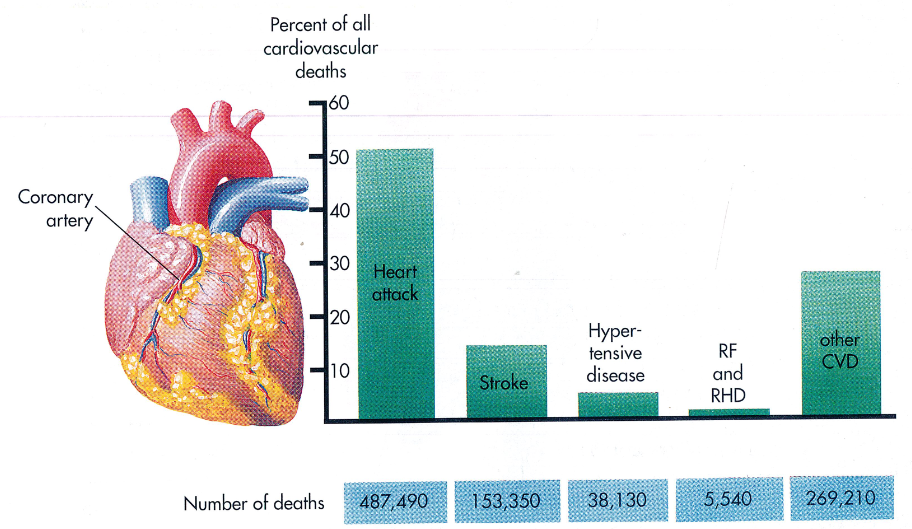
Cardiovascular diseases are directly related to over 40% of deaths in the United States and indirectly related to a large percentage of additional deaths.
Heart disease, stroke, and related blood vessel disorders combined to kill nearly 1 million Americans in 1994 (Figure 10-1). This figure represents more deaths than were caused by cancer, accidents, pneumonia, influenza, lung diseases, diabetes, and AIDS combined. Indeed, cardiovascular disease is our nation's number one "killer" 

NORMAL  CARDIOVASCULAR FUNCTION 
The cardiovascular or circulatory system uses a muscular pump to send a complex fluid on a continuous trip through a closed system of tubes. The pump is the heart, the fluid is blood, and the closed system of tubes is the network of blood vessels. 

The Vascular System

 The term vascular system refers to the body's blood vessels. Although we might be familiar with the arteries (vessels that carry blood away from the heart) and the veins (vessels that carry blood toward the heart), arterioles, capillaries, and venues are also included in the vascular system. Arterioles are the farther, smaller-diameter extensions of arteries. These arterioles lead eventually to capillaries, the smallest extensions of the vascular system. 
At the capillary level, exchanges of oxygen, food, and waste occur between cells and the blood. Once the blood leaves the capillaries and begins its return to the heart, it drains into small veins, or venules. The blood in the venules flows into increasingly larger vessels called veins. Blood pressure is highest in arteries and lowest in veins, especially the largest veins, which empty into the right atrium of the heart. 


The Heart 
The heart is a four-chambered pump designed to create the pressure required to circulate blood throughout the body. Usually considered to be about the size of a person's clenched fist, this organ lies slightly tilted between the lungs in the central portion of the thorax. The heart does not lie completely in the center of the chest. Rather, approximately two thirds of the heart is to the left of the body mid-line and one third is to the right. Two upper chambers, called atria, and two lower chambers, called ventricles, form the heart. The thin-walled atrial chambers are considered collecting chambers, whereas the thick-walled muscular ventricles are considered the pumping chambers.
 The right and left sides of the heart are divided by a partition called the septum. Study and follow the flow of blood through the heart's four chambers. For the heart muscle to function well, it must be supplied with adequate amounts of oxygen. The two main coronary arteries (and their numerous branches) accomplish this. These arteries are located outside of the heart  If the coronary arteries are diseased and not functioning well, a heart attack is possible. 

CARDIOVASCULAR DISEASE RISK FACTORS 

what are the factors of Cardiovascular Disease

As you have just read, the heart and blood vessels are among the most important structures in the human body. By protecting your cardiovascular system, you lay the groundwork for a more exciting, productive, and energetic life. The best time to start protecting and improving your cardiovascular system is early in life, when lifestyle patterns are developed and reinforced (see the Star Box at right). Of course, it is difficult to move backward through time, so the second best time to start protecting your heart is today. Improvements in certain lifestyle activities can pay significant dividends as your life unfolds. Complete the Personal Assessment on pp. 232-233 to determine your risk for heart disease. The American Heart Association encourages people to protect and enhance their heart health by examining the 10 cardiovascular risk factors that are related to various forms of heart disease' A cardiovascular risk factor is an attribute that a person has or is exposed to that increases the likelihood that he or she will develop some form of heart disease. Three risk factors are ones you will be unable to change. An additional four risk factors are ones you can clearly change. Three final risk factors are ones that are thought to be contributing factors to heart disease. 

Risk Factors That Cannot Be Changed 
The three risk factors that you cannot change are increasing age, male gender, and heredity.Despite the fact that these risk factors cannot be changed, your knowledge that they might be an influence in your life should encourage you to make a more serious commitment to the risk factors you can change. 
Increasing age 
Heart diseases tend to develop gradually over the course of one's life. Although we may know of a per-son or two who experienced a heart attack in their thirties or forties, most of the serious consequences of heart disease are evident in older ages. For example, approximately 80% of people who die from heart attack are age 65 and older. 
Male gender 
Young women have lower rates of heart disease than young men. Yet when women move through menopause (typically in their fifties), their rates of heart disease are similar to men's rates. It is thought that women are some-what more protected from heart disease than men because of their natural production of the hormone estrogen during their fertile years.
Heredity Like
 increasing age and male gender, this risk factor cannot be changed. By the luck of the draw, some people are born into families where heart disease has never been a serious problem, whereas others are born into families where heart disease is quite prevalent. In this latter case, children are said to have a genetic predisposition (tendency) to develop heart disease as they grow and develop throughout their lives. These people have every reason to be highly motivated to reduce the risk factors they can control. Race is also a consideration related to heart disease. African-Americans have moderately high blood pres-sure at rates twice that of whites and severe hypertension at rates three times higher than whites (for a detailed discussion of this topic, see "Focus on Hypertension among African-Americans). Hypertension significantly increases the risk of both heart disease and stroke. Fortunately, as you will soon read, hypertension can be controlled through a variety of methods. 


Alcohol Control

How To Taking Control of Alcohol Use

Alcohol Use

whether or not people use alcohol is often a reflection of  attitudes developed through the culture in which they live. How much they drink, what they drink, when they drink, and why they drink are all habits derived from their particular environments. Attitudes that a particular culture develops also influence rates of alcoholism. Times change, however, and countries are less isolated than they once were. Those cultural attitudes of a generation ago probably had more influence on behavior, such as drinking alcohol, than they do today. Still, culture does play a role in developing attitudes and behavior concerning alcohol consumption. 

Italy is the second largest wine-producing country in the world, and Italians have historically enjoyed drinking wine. Yet a generation ago, Italy's rates of alcoholism were low. Most Italians drank wine and approved of the practice. They typically drank wine with the noon and evening meals. Excessive drinking and drunkenness, however, were unacceptable.

 Jews, like Italians, have had low rates of alcoholism. Their attitudes toward drinking and drinking habits have been very similar to those of Italians.6 Attitudes continue to change in different cultures, but there are a few factors that seem to affect the rate of alcoholism. In societies in which alcohol is introduced to children in small amounts on special occasions and within a sound family structure, the rates of alcoholism are low. This is also true when drinking is not the main focus of entertainment but accompanies another activity. Conversely, high rates of alcoholism are common in cultures that seem to have no standards about how to drink and how much to drink.

 Consider the attitudes toward drinking within your culture and family. How do these attitudes and practices influence your own opinions toward alcohol use?

CHOOSING TO DRINK 
Clearly, people drink for many different reasons. We believe that most people drink because alcohol is an effective, affordable, and legal substance for altering the brain's chemistry. As inhibitions are removed by the influence of alcohol, behavior that is generally held in check is expressed. At least temporarily, drinkers become a different version of themselves—more outgoing, relaxed, and adventuresome. If alcohol did not make these changes in people, it would not be consumed as much. Do you agree or disagree?  

THE NATURE OF ALCOHOLIC BEVERAGES 

what are the Nature of Alcoholic Behaverages

Alcohol (also known as ethyl alcohol or ethanol) is the principal product of fermentation. In this process, yeast cells act on the sugar content of fruits and grains to produce alcohol and carbon dioxide. The alcohol concentration in distilled beverages (such as whiskey, gin, rum, and vodka) is expressed by the term proof, a number that is twice the percent-age of alcohol by volume in a beverage. Thus 70% of the fluid in a bottle of 140 proof gin is pure alcohol.Most proofs in distilled beverages range from 80 to 160. The familiar, pure grain alcohol that is often added to fruit punches and similar beverages has a proof of almost 200. 

The nutritional value of alcohol is extremely limited. Alcoholic beverages produced today through modern processing methods contain nothing but empty calories—about 100 calories per fluid ounce of 100-proof distilled spirits and about 150 calories per each 12-ounce bottle or can of beer.6 Clearly, alcohol consumption is a significant contributor to the additional pounds of fat that many college students accumulate. Pure alcohol contains only simple carbohydrates; it has no vitamins and minerals, and no fats or protein.

 "Lite" beer and low-calorie wines have been introduced in response to concerns about the number of calories that alcoholic beverages provide. These 'lite" beverages are not low-alcohol beverages but merely low-calorie beverages. Only beverages marked low alcohol" contain a lower concentration of alcohol than the usual beverages of that type. In fact, the popular new ice beers actually contain a higher percentage of alcohol than other types of beer. 

 THE PHYSIOLOGICAL EFFECTS OF ALCOHOL 
First and foremost, alcohol is classified as a drug a very strong CNS depressant. The primary depressant effect of alcohol is seen in the brain and spinal cord. Many people think of alcohol as a stimulant because of the way most users feel after consuming a serving or two of their favorite drink. Any temporary sensations of jubilation, boldness, or relief are attributable to alcohol's ability as a depressant drug to release personal inhibitions and provide temporary relief from tension. 

Factors That influence the Absorption of Alcohol 

The absorption of alcohol is influenced by several factors, most of which can be controlled by the individual. These factors include the following: • Strength of the beverage. The stronger the beverage, the greater the amount of alcohol that will accumulate within the digestive tract. • Number of drinks consumed. As more drinks are consumed, more alcohol is absorbed. • Speed of consumption. If consumed rapidly, even relatively few drinks will result in a large concentration gradient that will lead to high blood alcohol concentration. • Presence of food. Food can compete with alcohol for absorption into the bloodstream, thus slowing the absorption of alcohol. By slowing alcohol absorption, removal of the alcohol already in the bloodstream can occur. Slow absorption favors better control of blood alcohol concentration. • Body chemistry.

 Each person has an individual pattern of physiological functioning that may affect the ability to process alcohol. For example, in some conditions, such as that marked by "dumping syndrome," the stomach empties more rapidly than is normal, and alcohol seems 
to be absorbed more quickly. The emptying time may be either slowed or quickened by anger, fear, stress, nausea, and the condition of the stomach tissues.

Disqus Shortname

Comments system